Table of Contents
Crafting Your Perfect Moroccan Adventure: A Personal, Step-by-Step 10-Day Morocco Itinerary Journey
Let’s talk about planning a trip to Morocco. You’ve seen the pictures the dizzying souks, the endless desert, those blue alleyways that don’t look real. You’re hooked. But the moment you start piecing it together, the question hits: How on earth do I turn this dream into an actual plan? Booking sites, map distances, tour options it’s a lot. Having navigated this maze myself, more than once, I’m here to walk you through it, not with a generic list, but with the real, practical blueprint I wish I’d had. This is a 10-day loop that captures Morocco’s soul, balancing awe with logistics. Let’s build your itinerary.
The Golden Rule: It’s a Loop, Not a Back-and-Forth
First, fundamental geography. Casablanca and Marrakech are in the west. Fes and Chefchaouen are in the north. The Sahara Desert (Merzouga) is way out east. Driving back and forth between these points is a brutal waste of precious time. The key is to move in one sensible direction. The classic, and for good reason, is the Marrakech-Desert-Fes loop. You fly into one city, out of another, and never retrace your steps. This 10-day plan follows that wisdom, adding a necessary dip into the north for that famous blue hue.
Your Day-by-Day Roadmap: The Heartbeat of the Trip
Here’s the skeleton we’ll flesh out:
- Days 1-3: Marrakech. Arrival, immersion, and culture shock in the best way.
- Days 4-6: The Road Trip. Atlas Mountains to the Sahara Desert, ending in Fes.
- Days 7-8: Fes. A deep dive into ancient, medieval intensity.
- Day 9: Chefchaouen. The calming, blue-toned palette cleanser.
- Day 10: Departure from the north.
Part 1: The Pulse of the South – Marrakech (Days 1-3)
Day 1: Arrival & First Night in the Labyrinth
Your adventure begins the second you land at Marrakech Menara Airport (RAK). My strongest advice: pre-book an airport transfer with your riad. After a long flight, haggling with taxi drivers and then being dropped at the medina gate to search for your hidden alleyway accommodation is a special kind of exhausting. That first ride, watching the city approach, is when the excitement truly kicks in.
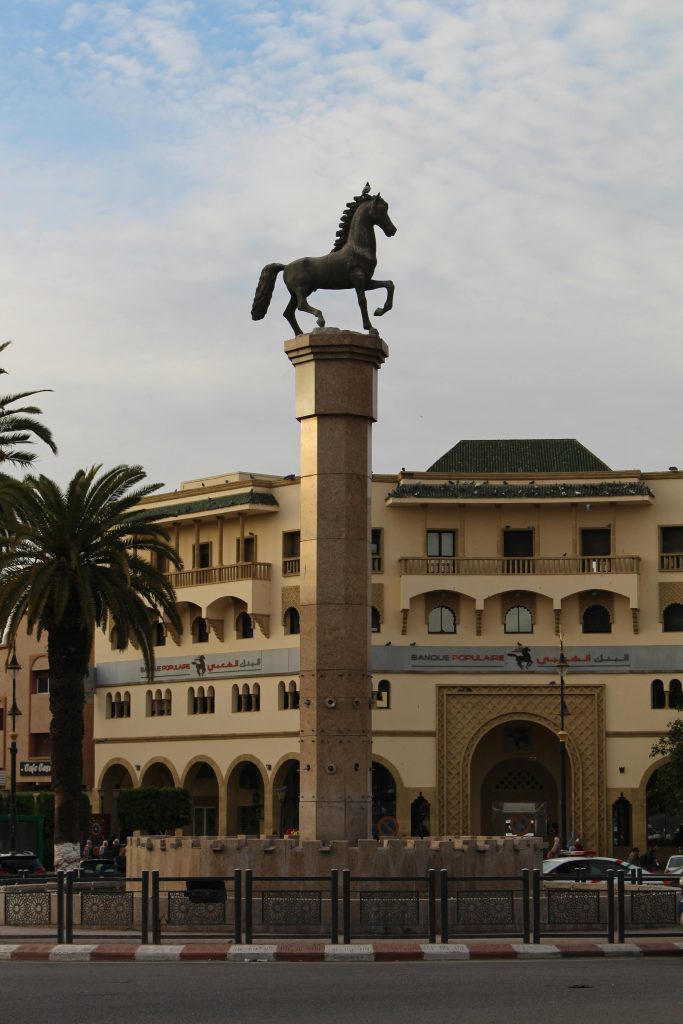
Check into your riad. A riad is a traditional Moroccan house with an interior garden courtyard. It’s your sanctuary. Then, go get lost. Head straight for Jemaa el-Fnaa, the central square. Go as the late afternoon sun washes everything in gold. Watch the snake charmers, the juice vendors, the crowds. As dusk falls, the square transforms. Smoke rises from hundreds of food stalls, each numbered, each shouting for your business. The air fills with the scent of grilling meat and spices. Don’t be shy point at what looks good. It’s chaotic, vibrant, and utterly unforgettable. This is your welcome to Morocco.
Day 2: History, Color, and the Art of the Souk
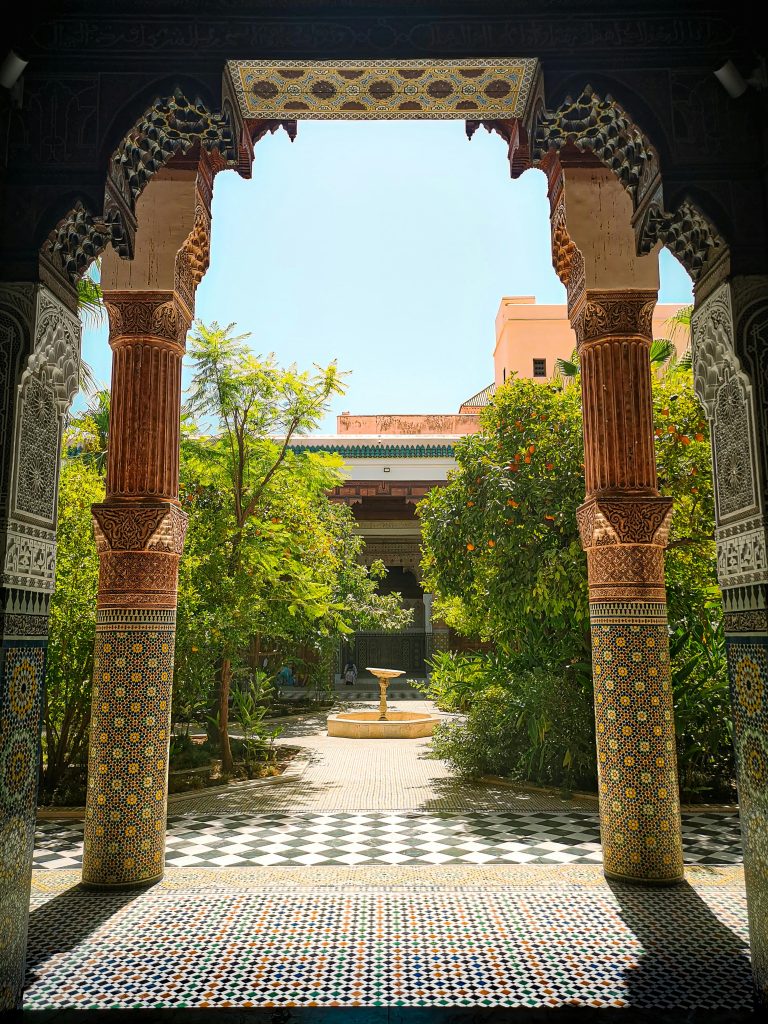
Today is for the icons. Start at the Bahia Palace. This isn’t just a museum; it’s a lesson in beauty. Every inch of cedar, stucco, and tile is carved, painted, or laid by master craftsmen. The light filters through latticework, painting the floors. It’s peaceful and awe-inspiring.
From history, move to living art: the Majorelle Garden. Book your ticket online the night before the lines are long. Once inside, the cobalt blue pavilions, the shocking yellows and greens of the cacti, the quiet hum it’s a world away from the medina’s frenzy. It’s the vision of artist Jacques Majorelle, saved by Yves Saint Laurent. You’ll understand why.
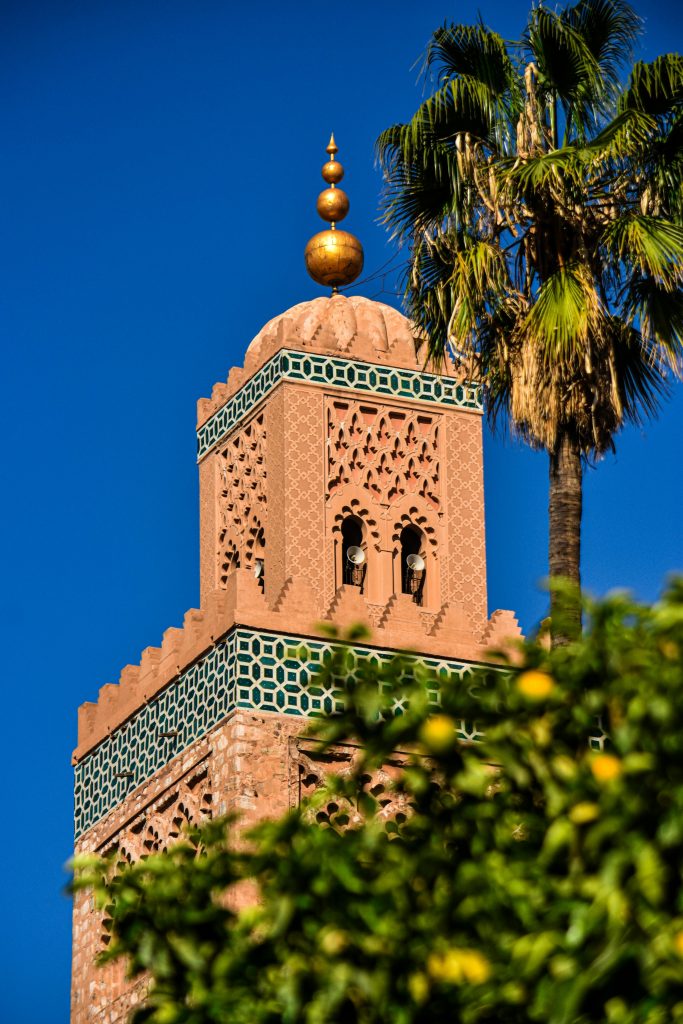
Now, the afternoon challenge: the souks. Enter from the north side of Jemaa el-Fnaa. Don’t have a plan. Let yourself be pulled down narrow alleys under bamboo roofs. Past stalls of leather babouches, piles of spices in rainbow mounds, lanterns casting fractured light, and men hammering silver. You will get lost. Use it as an opportunity. When you’ve had enough, simply ask a shopkeeper for directions to “Jemaa el-Fnaa” they’ll point you home. For dinner, find a rooftop cafe. Watching the swallows circle the Koutoubia Mosque as the call to prayer echoes is a perfect Marrakech moment.
Day 3: Secret Corners & Local Flavors
Step slightly off the main path today. Visit the Saadian Tombs, a royal burial ground walled up and forgotten for centuries, only rediscovered in 1917. The detail in the chamber of the twelve columns is breathtaking. Then, walk the city ramparts. Their sheer scale reminds you this was a mighty fortress city.
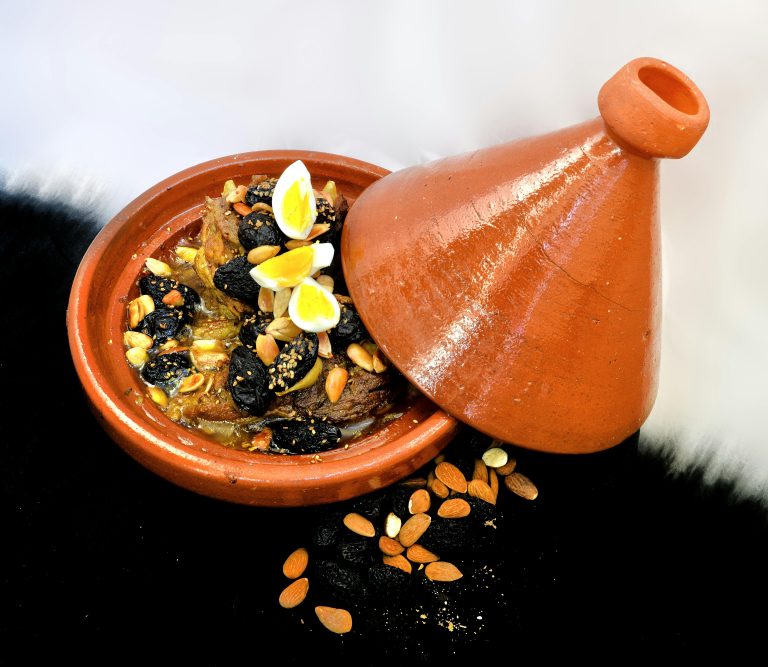
Consider a Moroccan cooking class. This isn’t just about food; it’s a cultural immersion. You’ll be guided through the souk to buy ingredients, learning about spices and produce, before spending hours in a kitchen learning to craft a tagine or bake bread. You eat your masterpiece for lunch. Alternatively, treat yourself to a traditional hammam. The public ones are an intense local experience, but for your first time, a spa-like session at a place like Les Bains de Marrakech is transformative steam, black soap, a vigorous scrub, and a massage that leaves you reborn.
Your final evening? Book a table at a refined restaurant like Le Jardin or Nomad in the medina. It’s a chance to savor the flavors in a serene setting.
Part 2: The Epic Journey – Mountains to Desert (Days 4-6)
Day 4: Into the High Atlas & Hollywood of Africa
This morning, your driver/guide will meet you. Booking a private 4×4 tour for these three days is non-negotiable. It’s comfort, safety, flexibility, and insight rolled into one. You leave Marrakech behind and ascend the Tizi n’Tichka pass. The road snakes up into the High Atlas, views becoming more jaw-dropping with every turn. Berber villages cling to mountainsides.
Your destination is Ait Ben Haddou. This isn’t a movie set; it’s a living, breathing 17th-century ksar (fortified village) that happens to have been in Gladiator, Game of Thrones, and countless other films. Cross the river on foot and climb through its earthen passages. At the top, the view over the palmeraie and the distant mountains is worth every step. You’ll spend the night further east in the Dades Valley, often in a kasbah-hotel overlooking the surreal “Monkey Fingers” rock formations. The silence here, under a blanket of stars, is profound.
Day 5: Gorges & The First Glimpse of Dunes
After breakfast, a short drive brings you to Todra Gorge. Here, the river has carved a sheer cliff face 300 meters high, with just a narrow strip of sky above. You can walk along the riverbed, feeling incredibly small. It’s a popular spot for rock climbers and a beautiful place for a morning stroll.
The landscape then shifts dramatically as you drive toward the Sahara. The green gives way to rocky hamada (stone desert), and then, on the horizon, you see them: soft, golden peaks. The Erg Chebbi dunes. In the late afternoon, you’ll reach Merzouga, the gateway village.
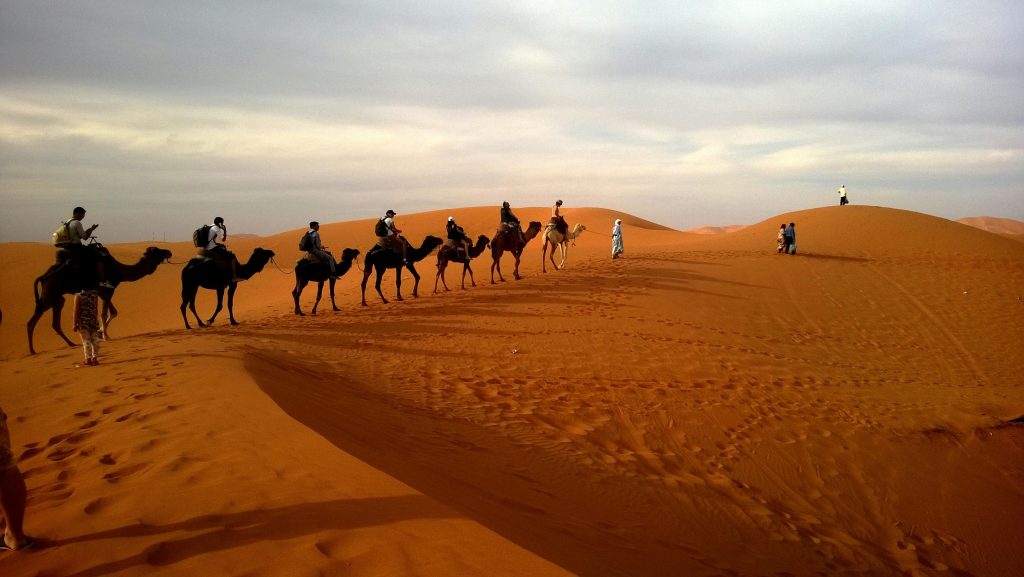
Leave your big bag at your auberge pack an overnight small bag. Now, the magic: a camel trek into the dunes. The rhythm is slow, peaceful. The only sound is the soft plod of feet in sand. You’ll arrive at your desert camp as the sun begins to dip, turning the sand from gold to fiery orange to deep rose. Climb a high dune to watch the sunset. After a tagine dinner, gather around the fire for Berber drumming under a sky so dense with stars it feels tangible.
Day 6: Sunrise & The Long Road to Fes
Wake before dawn. It’s cold. Wrap yourself in a blanket and climb the dune again. Watching the sun rise over the sea of sand, painting long shadows, is a moment that stays with you forever. After breakfast, camel-trek back to your vehicle.
Today is a long travel day (roughly 8-9 hours), but the scenery is part of the attraction. You’ll drive through the immense Ziz Valley, a green ribbon of palm trees cutting through a rocky gorge. Stop in Midelt, a market town in the heart of apple country, for lunch. You’ll wind through the Middle Atlas mountains, possibly seeing herds of nomadic goats or monkeys in the cedar forests near Azrou. You’ll arrive in Fes in the evening, weary but filled with the memories of the open road. Your riad in the Fes medina will be a welcome sight.
Part 3: The Medieval Mind – Fes (Days 7-8)
Day 7: Getting Lost (With a Guide)
Fes el-Bali, the old medina, is a different beast to Marrakech. It’s older, denser, more intense, and a true labyrinth. Today, hire an official local guide. It’s worth every dirham. They’ll navigate the 9,000 alleyways, explain what you’re seeing, and handle any minor hustles.
The highlights are sensory overload in the best way: the tanneries (where you’ll be given mint to smell against the pungent odors), seeing the vast vats of dye; the stunning Al-Attarine Madrasa, a theological school of breathtaking geometric precision; the Bou Inania Madrasa, an active religious site with incredible woodwork; and the foundouks (old caravanserais) now housing artisan workshops. Your guide will take you to a viewpoint for the famous “sea of rooftops” photo. For dinner, treat yourself to a multi-course Fassi feast at a place like La Maison Bleue.
Day 8: Above and Beyond the Walls
See the medina from above at the Merinid Tombs. These ruined tombs on a hillside offer the definitive panoramic view, especially at sunrise or sunset. Then, explore Fes el-Jdid (“New Fes,” from the 13th century), home to the imposing Royal Palace gates (you can’t enter, but the doors are spectacular) and the historic Mellah (Jewish Quarter), with its distinct architecture.
Use your final afternoon for last-minute shopping (Fes is known for fine leather, ceramics, and metalwork) or a final cultural hit. The Dar Batha Museum houses a lovely collection of traditional arts in a beautiful Hispano-Moorish palace. Alternatively, simply sit in a café by the Bab Bou Jeloud gate and watch the world donkeys, merchants, tourists, students pour through.
Part 4: The Blue Calm – Chefchaouen & Departure (Days 9-10)
Day 9: The Rif Mountains & A Wash of Blue
A private transfer (about 4 hours) takes you north into the Rif Mountains. The landscape turns lush and green. And then, you see it: a town cascading down a hillside, painted in every conceivable shade of blue. Chefchaouen is as dreamlike as the photos suggest. The blue is said to have been introduced by Jewish refugees in the 1930s, symbolizing the sky and heaven.
There are no “must-see” sites here. The activity is wandering. Get lost in the blue alleyways, stumble upon tiny squares, chat with friendly shopkeepers (the vibe is much more relaxed here). Hike up to the Spanish Mosque on the eastern hill for sunset. The view of the blue town, nestled in the valley, bathed in golden light, is pure magic. Dinner is simple, often from a family-run spot in the medina.
Day 10: A Final Breath of Mountain Air & Departure
Enjoy a slow morning. Sip coffee on a blue terrace. Buy some of the local, wonderfully soft wool garments. Then, it’s time to go. The most efficient airport for departure from here is Tangier Ibn Battuta (TNG), about a 2-hour drive. If your international flight leaves from Casablanca (CMN), you’re looking at a 5-6 hour drive or a short internal flight from Tangier. As you travel, you’ll replay the highlights in your mind the chaos, the silence, the colors, the flavors. You didn’t just visit Morocco; you experienced its many hearts.
Essential Travel FAQs for Your 10-Day Morocco Itinerary
Q: Is 10 days really enough for Morocco?
A: It’s perfect for a first, comprehensive trip. You hit the major highlights the energy of Marrakech, the Sahara, the history of Fes, and the charm of Chefchaouen without feeling brutally rushed. If you have more time, you can add Essaouira or the coast, or spend extra nights in the desert.
Q: How do I book the desert tour from Marrakech to Fes?
A: Research reputable tour operators online (look for consistent, recent reviews). You can book in advance from home or, with more flexibility, arrange it through your Marrakech riad a day or two after you arrive. Ensure it includes all meals, accommodations (desert camp + hotels), and transport for the 3 days.
Q: What should I pack for the Sahara Desert night?
A: Even in summer, the desert gets cold at night. From October to April, it can be freezing. Pack layers: a warm fleece, a down jacket, long pants, thermals, a hat, and gloves. Your desert camp will provide blankets, but being prepared is key to enjoying the starry night.
Q: Is it safe to travel between these cities?
A: The routes described are very well-traveled and generally safe. Using a trusted tour operator/driver for the cross-country portion provides an additional layer of security and convenience. Petty theft (like pickpocketing in crowded souks) is the main concern stay vigilant with your belongings.
Q: What’s the budget for a 10-day trip like this?
A: It varies wildly. A budget traveler using hostels and group tours could manage on $60-80/day. A mid-range traveler staying in nice riads, using a private desert tour, and eating well should budget $120-200/day. Luxury (5-star riads, premium tours) starts at $300+/day, excluding flights.
Q: What’s the one thing you wish you’d known before your first trip?
A: To slow down. Don’t try to tick every box. Sit in a café and watch life go by for an hour. Accept that you’ll get lost. Say yes to the mint tea offered by a shopkeeper, even if you don’t plan to buy. The greatest moments often come from the unplanned spaces between the sights.